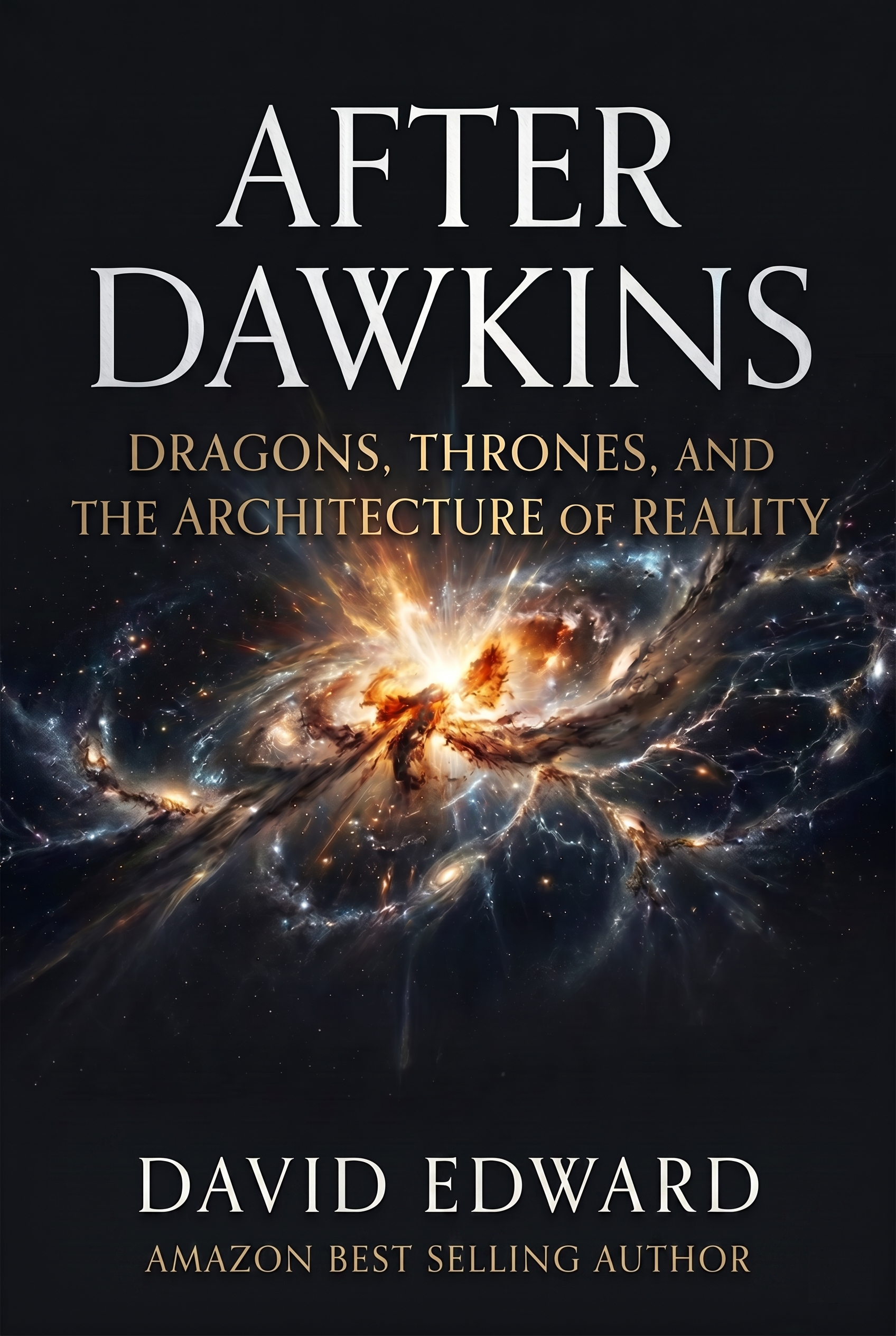
After Dawkins
Dragons, Thrones, and the Architecture of Reality
A philosophical thought experiment that takes the so-called war between science and religion and resolves it, by gently correcting both sides, and not-so-gently correcting one particular British biologist along the way.
Be there on the day the door opens.
Join the list to be notified when After Dawkins is released. No marketing noise. One email, when the book is in your hands.
Eleven corrections. One coherent worldview. Arriving soon.
A worldview, reassembled.
They told you science killed God. They were wrong about that. They were also wrong about science.
After Dawkins is a thought experiment with the audacity of a manifesto and the patience of someone who has actually done the homework: in the original Hebrew, in Maxwell's equations, in Darwin's actual closing paragraph (which says something very different than you have been told), and in the architecture of Revelation.
Working correction by correction, the author argues that the famous war between science and religion is not a war at all. It is a series of translation errors, dropped premises, and quiet substitutions that scholars on both sides have been carrying forward for centuries without noticing.
What stands on the other side is a coherent worldview. And it carries very good news.
Eleven corrections. One coherent universe.
No comfortable assumptions survive. Not yours, not your pastor's, not Richard's.
Genesis Opens with Space
Not a temporal moment, but a spatial position. The Hebrew has been hiding in plain sight for centuries.
Time Is the First Dimension
Not the fourth. The standard account has been counting in the wrong order since Einstein.
Light Is Four-Dimensional
Genesis 1:3 and electromagnetic physics describe the same geometric structure, in stunning agreement.
Darwin Credited the Creator
In his closing paragraph. Modern biology has been quietly editing him out of his own book.
Ussher and Genetic Entropy Agree
Both point to October 4004 BC. Not the date of creation. The date the system broke.
The Fall Was Fraud
Not fruit. A commercial scheme run from inside the polity above us. We are the victims, not the defendants.
Written for the curious reader, the academic mind, and the believing heart.
For The Curious Reader
If you have ever finished a book on cosmology, picked up a translation of Genesis, and wondered why no one seems to be reading them as if they describe the same universe, this book was written for you.
After Dawkins belongs on the shelf next to the volumes you reach for when you want to be made to think, not flattered. It is intellectually rigorous, conversational, occasionally cheeky, and built for the reader who refuses to accept that hard questions belong only to specialists.
Bring intellectual seriousness, a sense of humor, and every preconception you have. By the end you will have new ones. They might even be right.
For The Academic Mind
Students of physics, biology, philosophy, theology, and the history of science will find a sustained act of attention here: ancient texts and modern science taken with equal seriousness, contradictions allowed to resolve themselves rather than papered over.
The book reopens foundational claims most syllabi have stopped examining. Genesis in Hebrew. Maxwell's equations. Darwin's actual closing paragraph. Ussher's chronology set beside genetic-entropy data. The geometry of Revelation rendered with mathematics too clean for a first-century fisherman to have invented.
Eleven corrections, carried correction by correction. The kind of argument a seminar room was built for.
For The Believing Heart
If you have ever felt that the choice between honest science and faithful reading of Scripture was a choice you should not have to make, you were right. After Dawkins shows why.
There is a hero, and his résumé runs through Job 38 and Psalm 45: world-builder, dragon-slayer, hidden prince elevated by his Father, bridegroom coming for the bride. Every story you ever loved is an echo of his. There is a polity above us, with councils and armies and a working economy. There is a destination, described in Revelation with surgical geometric precision. And there is meaning: receive from above, pass it downward.
Eternity is not clouds and harps. It is a working city at the heart of a renewed cosmos, with always-open gates and real roles waiting.